
For AI companies
Paid ads for AI products, judged on what you keep
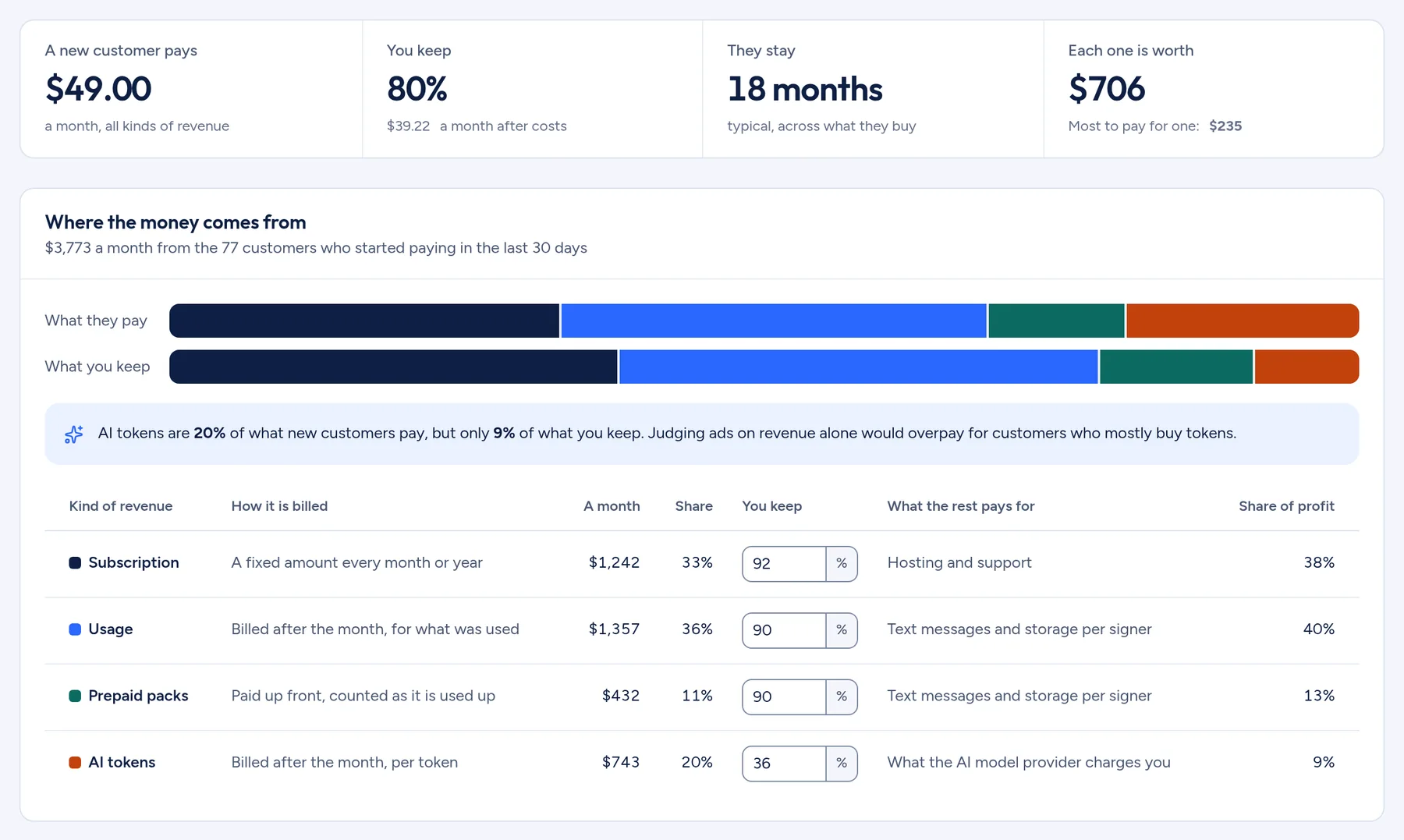
An AI product rarely has one price. Customers pay for a plan, then for tokens, credits or usage on top, and every token has a cost behind it. Revenue alone overstates what an ad brought in. ReadyLift reads your pricing, values each new customer after costs, and sets the most you should pay to win one.
Why revenue misleads an AI company
- Token revenue is not margin
- Tokens can be a large share of what customers pay and a small share of what you keep. Ads judged on revenue overpay for customers who mostly buy tokens.
- Usage is unknown on day one
- Nobody knows how much a new account will use. A customer starts at a typical figure and is corrected with real invoices after each full month.
- One number hides the mix
- A single revenue-per-account figure is wrong for a business that blends plans, usage, prepaid packs and tokens. Each kind has its own share kept after costs.
Four kinds of revenue, valued separately
Subscription, usage, prepaid packs and AI tokens. Point ReadyLift at your pricing page, your billing catalog, past invoices or a document. It reports what it found, how sure it is of each line, and the questions only you can answer.
The most to pay for a customer
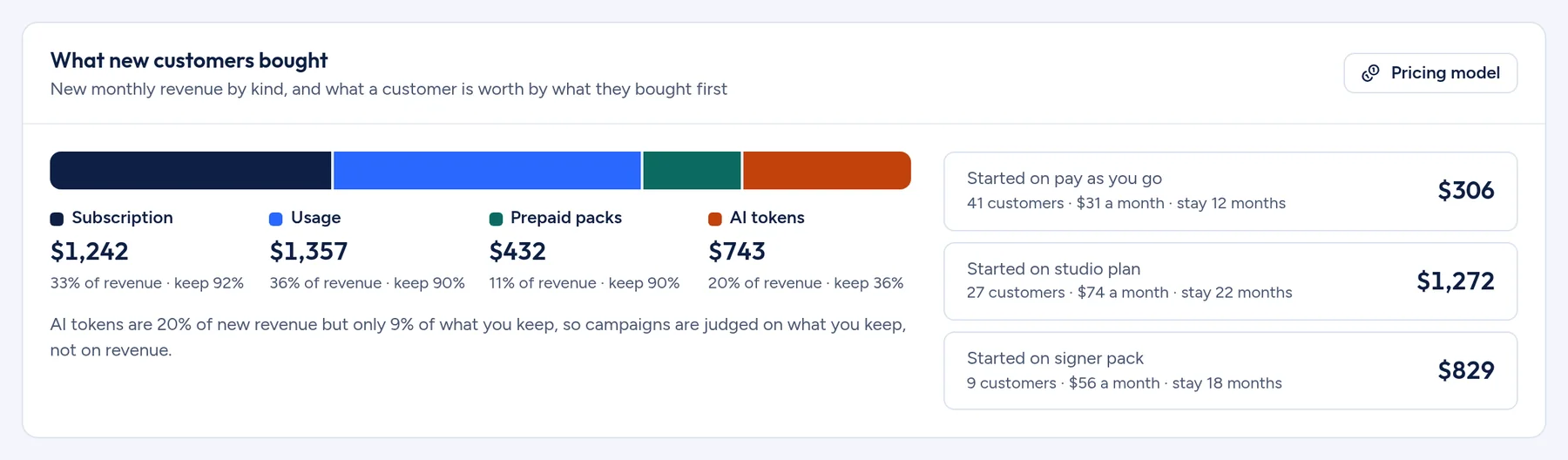
The CAC ceiling is a customer’s worth divided by your target LTV to CAC. The dashboard, each campaign’s guardrail and the agent all judge by it.
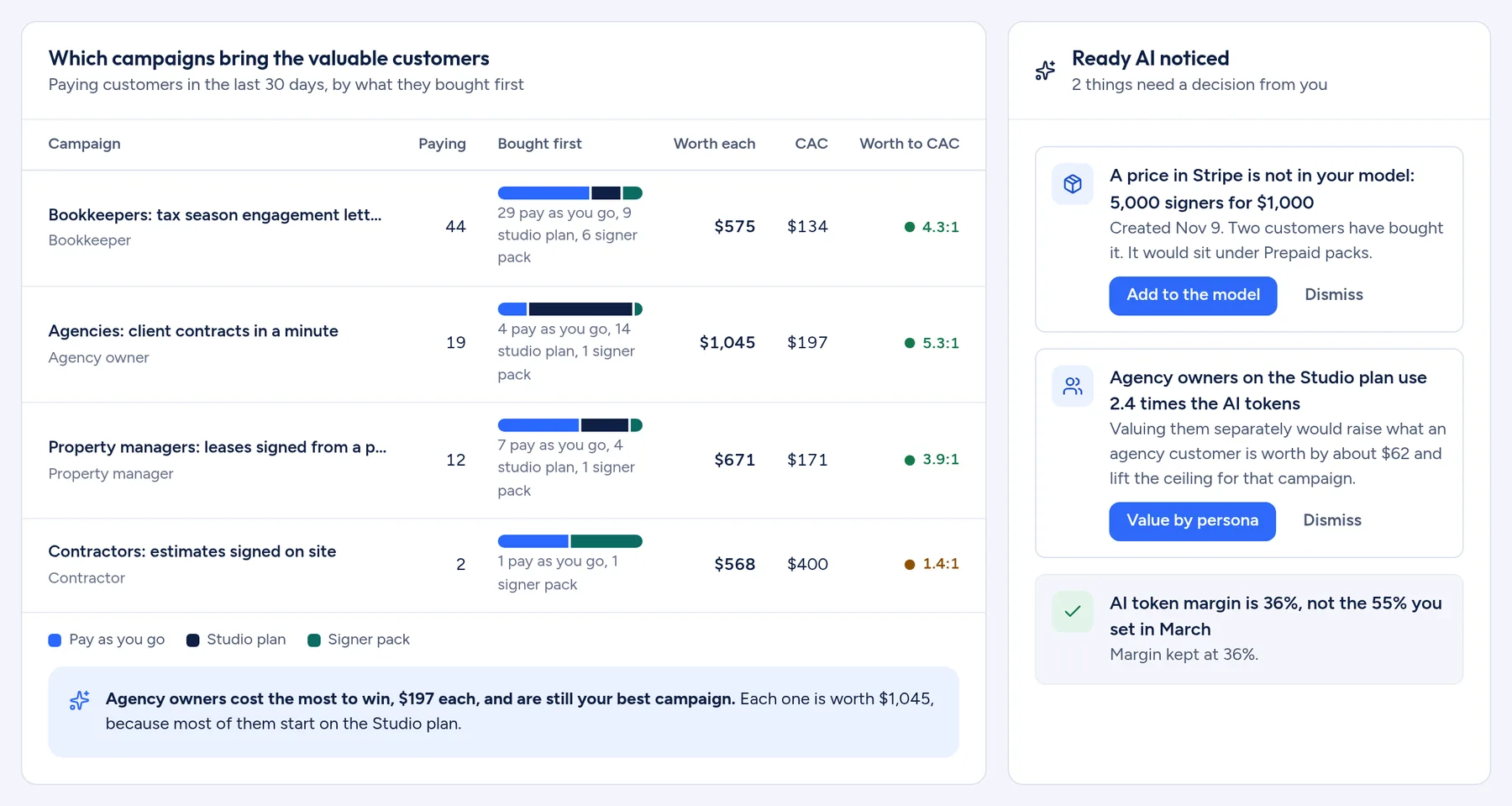
Campaigns are compared on the worth of the customers they bring, not only on how many. The costliest campaign to win from can still be the best one.
Your product reports the outcome
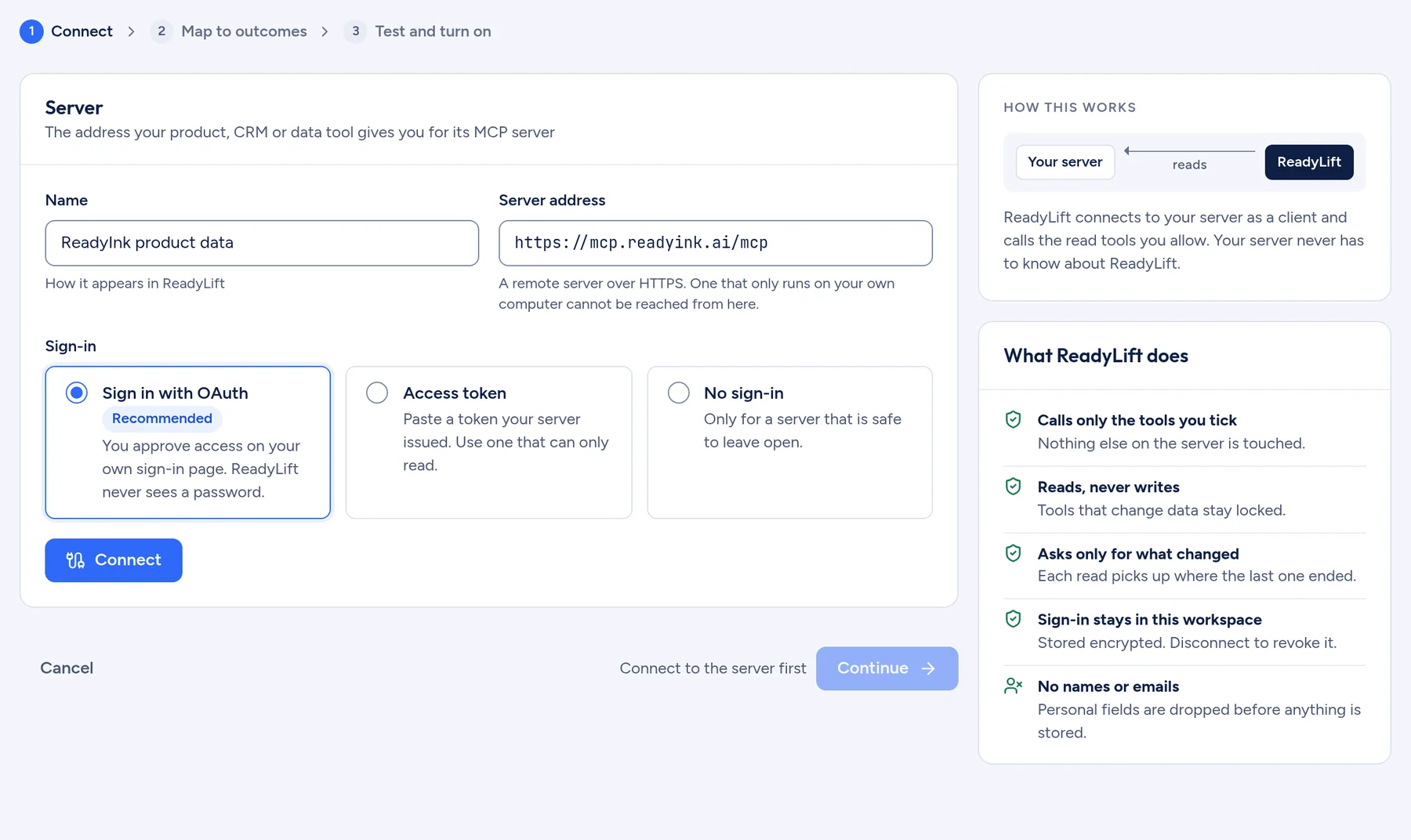
Your product knows when a trial starts and when an account becomes active. It reports those through an MCP server that ReadyLift reads, or through the Events API from your own server. Stripe supplies the payment.
With an MCP server, ReadyLift connects as a client, calls only the tools you tick and never calls a tool that changes data.
ChatGPT Ads next to Google and Meta
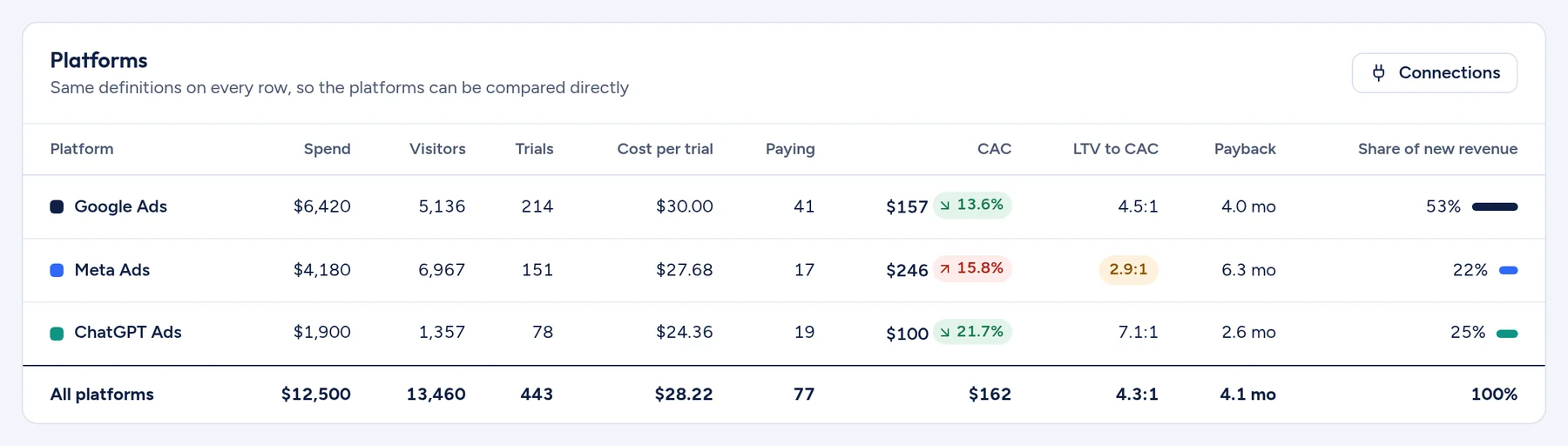
ChatGPT Ads shows a sponsored line beside a related conversation. ReadyLift runs it from the same persona and landing pages as your other platforms, then compares what a paying customer costs on each one. Access depends on where OpenAI offers it; see Advertise in ChatGPT from OpenAI.
Ask ReadyLift from ChatGPT or Claude
ReadyLift has its own MCP server. Add its address to ChatGPT, Claude or any assistant that supports MCP, and ask what a paying customer cost, which test is winning and what the agent proposes.
An agent you can check
Every proposal shows its evidence, the effect it expects and a confidence level. You choose whether the agent asks before every change or applies changes within limits you set. In every setting it never raises your total daily budget and never deletes anything.
Questions
Before you ask
Does the pricing model handle credits and prepaid packs?
Yes. Prepaid packs are one of four kinds of revenue in the pricing model, next to subscription, usage and AI tokens. Each has its own share kept after costs.
Our pricing changes often. Does the model keep up?
The model is re-checked every night against your billing catalog, and anything new waits for your decision. A new model applies from the day you save it and never rewrites past results.
Do we need Stripe?
No. Stripe is the quickest way to supply the Paid outcome. Without it, send payments from your own server with the Events API, or from a billing tool that can send webhooks.
Can ReadyLift read outcomes from our own MCP server?
Yes. ReadyLift connects to it as a client and reads the outcomes you choose. It calls only the tools you tick, and tools that change data stay locked.
Can we use ReadyLift from ChatGPT or Claude?
Yes. ReadyLift has its own MCP server, which ChatGPT, Claude or any assistant that supports MCP can connect to. The assistant reads your results and the agent’s proposals. Changes to your ads still need your approval.
Go deeper
See what your ads are really buying
ReadyLift.ai is opening to a first group of SaaS and AI companies. Tell us where you advertise and we will be in touch.